Friday, January 7, 2011

Vatsalya

And your own life while its happening to you never has any atmosphere until it becomes a memory.
       -- Andy Warhol


I was paired with Vatsalya, www.vatsalya.org.  The organization was initially created to help street children but has since expanded to other projects as well.  The organization runs a clinic around the truck rest stop in Jaipur, where doctors test long distance truck drivers for STIs (sexually transmitted infections).  Although HIV awareness activities are conducted around the area outside the clinic, the clinic does not have a lab so patients are referred to government facilities for testing.  Vatsalya also runs a "sex workers project" in Ajmer, 3 hours west of Jaipur.  This project is more awareness oriented, as educators go out to sex worker hot spots and teach prostitutes to protect themselves from HIV and other sexually transmitted infections.


The other volunteer and I were first taken to the orphanage in Acherol, called "Udayan".  Both middle men had failed to inform the parent organization that we would be coming, so we kind of just showed up.


It was cold.  The orphanage was placed far back from the main road.  It was peaceful and quiet.  We arrived right before prayer time and met another volunteer who was on her way out, also American.  We watched the children say prayer.  Beautiful.  Singing and lots of repetition of the word "shanti", peace in Hindi.


After dinner we went into the kitchen to get chai.  The kitchen staff mostly just spoke Hindi, but we stayed and socialized.  The big aunty in the kitchen said something in Hindi about me being a boy, or boy hair (my Hindi isn't good enough to really know) and I replied indignantly, "Meh lerki hu!"... "I'm a girl!" and pretended to look upset, which they all thought was hilarious.  I started talking with one boy putting ghee on chapati.  He told me he was from South Africa.  Apparently, there are no elephants there, but dinosaurs are a common sight.


Both nights I stayed there there was a traveling group of musicians.  Good evening entertainment, but I was so jet-lagged I fell asleep and the singer was making fun of me in Hindi and Urdu.  oops.  


From the other volunteer, we learned more about the organization and got some useful tips.  She had a lot of pent up frustrations and most of what she said was pretty negative.  I told her that night


You are going to get home and find out that you experienced a lot more than you think


After that she had a much better attitude and realized, despite how awful and frustrating some things were, she really had experienced India.  Some things, the only thing you can do is laugh.
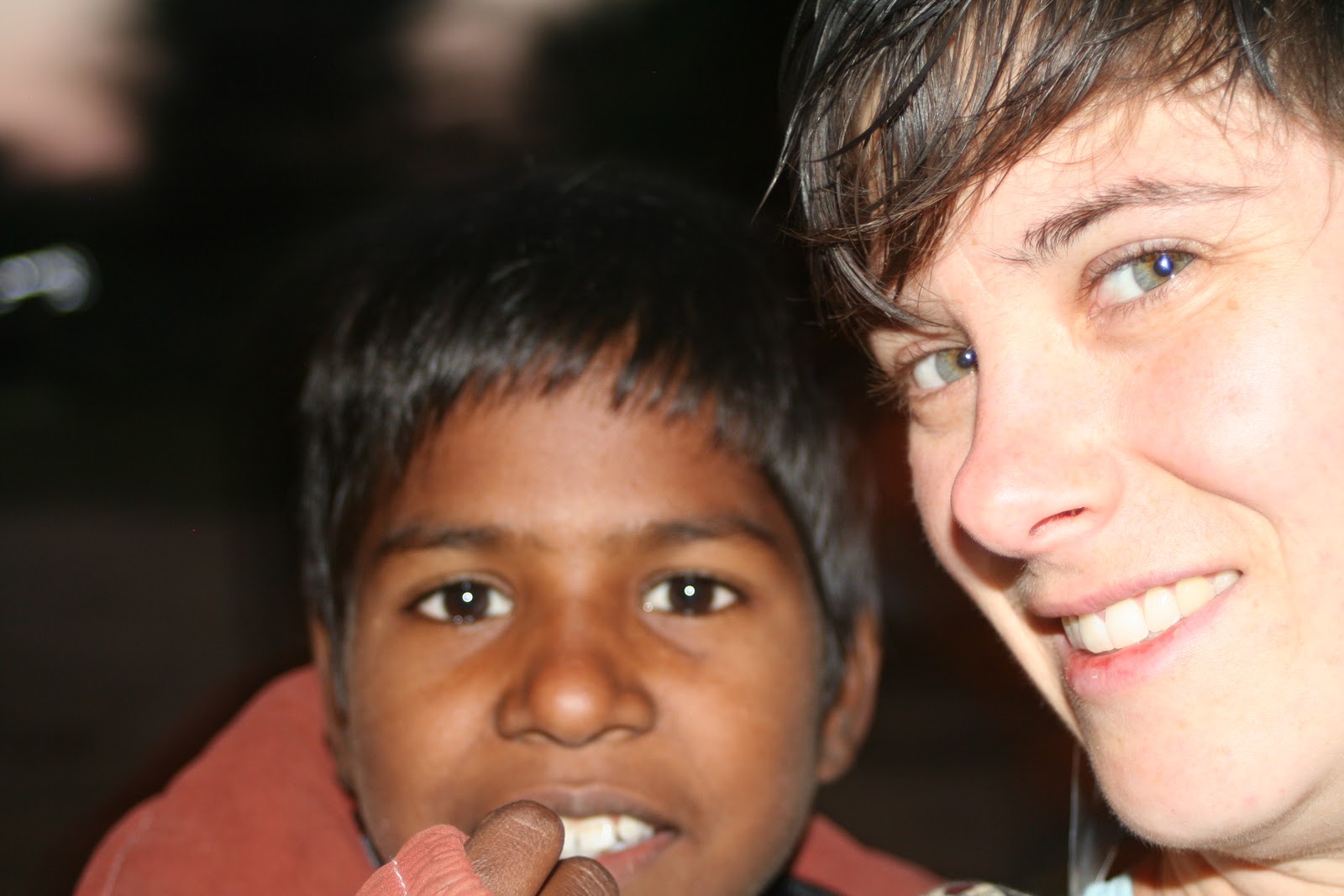
I only stayed at Udayan for 2 nights.  Most of what I saw was all smiles.  Playing with the kids and trying to learn Hindi from them at meal times.  I picked up a book in the dorm I was staying in, written by Jaimala, one of the founders of Vatsalya, "Eighteen million question marks: The street children of India".  She had written about the children of Vatsalya, changing their names.  It was hard to believe what these children had been through before coming. 


In particular, I learned of one little girl who was less than 12 years old but had learned how to take care of herself on the streets by giving sexual favors.  Mistaking this for love, she continued to "sex play" and to try to get the other children to engage.  As a result, she lived separate from the other children and had special counseling.


Despite their pasts, children are children.  They have the same needs for attention and my interactions had been the same as those with American children and the children of Tanzania.  My favorite memory is ballroom dancing to Hindi music with some of the little girls on my last morning before they went off to school.


We met the founders of Vatsalya on the second night who had come to see the music group and discussed our goals for volunteering.  Despite not knowing about us until we had showed up, they were very accommodating and we arranged to go to Jaipur the next day.

Love Affair

I wonder if its possible to have a love affair that lasts forever
    -- Andy Warhol


I returned from spending 4 1/2 weeks in India last night and have been reviewing my journal, trying to make sense of the things that I experienced.  Despite how quickly that time went by, I think of my first few days and the things that I felt and experienced and it just seems lightyears away.


I arrived in Delhi on December 6, at 2 am Indian time, which was 1 pm Boston time.  Flight was without incidence and, despite my insecurities, someone from my volunteer organization had sent a driver to get me.


I struggled to make conversation (I'm sure the driver just wanted to sleep) and gazed out the window, trying to catch a glimpse of the city which was covered in thick white fog or smoke.


"Has there been a fire recently?" I naively asked.


Actually Delhi, as well as many other Indian cities, is just so polluted that it is always densely covered in smog.  Lucky for me, when photographed it kind of just looks like a mystical mist.  Unlucky, it was a struggle to breathe and I developed an upper respiratory infection during my second week (which I treated with azithromycin, Indian regimen 500 mg for 3 days).


Back at volunteer headquarters, I immediately fell asleep.  I struggled to wake up the next morning and met the other volunteers.  After socializing, we were given a 30 minute introduction to India, Hinduism, and Hindi.  I had unknowingly went through 2 middle men for the volunteer placement, so all of us were to be split up into separate projects.  Only one other volunteer, a 20 year old American male, and I were doing the HIV program, which was based out of Jaipur.  We went with the coordinator afterwards to get a bus.


After 10 minutes of waiting for a bus, the coordinator decided his time was not to be wasted and started to arrange for us to go by cab.  I saw a man approaching.  He was covered in white and red face paint, adorned with jewelry, and while his chest was bare, he had cloth hanging about his neck.  I looked down and noticed he had a decorative dagger on a belt about his waist... and nothing else on.


I averted my gaze so as not to see his unholy genitals.  He came right to my face and was muttering something in, most likely, Hindi.  He showed me a sixth finger growing out of the side of each pinkie and wiggled them for me.  This must be where he got his holy powers.  He then moved on to the other American and proceeded to bless him.  


We were thankfully saved by the coordinator who had finished arranging the cab and jumped into the car.  The holy man kept his head pressed close to the car window, still chanting, but thankfully the car door blocked view of his genitals.


"I just saw that man's penis."  the American said.


Welcome to India.  This is going to be an adventure.

Sunday, November 28, 2010

Favism

Favism.  G6PD deficiency.  Name derived from the hemolytic anemia a patient with G6PD deficiency will suffer after consuming fava beans.  My preceptor at my most recent rotation recently emailed me, asking if I would fill a prescription for the second generation antihistimine, meclizine, for a patient with G6PD deficiency.  Before I could answer, I had to take a few steps back and look at what exactly G6PD deficiency is.


G6PD, or glucose-6-phosphate dehydrogenase, is the rate limiting enzyme for a process that produces NADPH as a byproduct.  NADPH is a reducing agent used in the synthesis of fatty acids and cholesterol and is also utilized to protect cells from oxidative damage.
NADPH is essential to erythrocytes, which having no nucleus, during their 120 day lifecycle are unable to synthesize new proteins to repair cellular damages.  Erythrocytes rely heavily on reducing agents, like NADPH, to protect against oxidative damage.
Patients with G6PD deficiency have genetic mutations in the glucose-6-phosphate dehydrogenase enzyme.  The mutation in the enzyme determines the severity of the NADPH deficiency, and therefore the ability of erythrocytes to react to oxidative damage.  
Under conditions of oxidative stress when NADPH supplies are not sufficient to reduce the damage done to the cell, oxidized hemoglobin clumps together within the erythrocyte creating Heinz bodies, which are characteristic of G6PD deficiency.  This leads to hemolytic anemia, as the red cells burst and die.  
Symptoms of G6PD deficiency are brought on by oxidative stress; a variety of stressors can bring about hemolytic anemia.  Infections, diabetic ketoacidosis, fava beans, and some medications can bring on hemolytic anemia within days of exposure.  
Hemolytic anemia is often brought on by medications in patients with G6PD deficiency when glutathione reduces the medication in the liver during the metabolism process.  In order for the body to return glutathione to its usable state, the oxidized glutathione is reduced by NADPH.  When the mutant enzyme cannot keep up with replacing the NADPH stores, erythrocytes begin to suffer oxidative damage and anemia results, with the tell-tale Heinz bodies, dark urine, and often patients experience back-ache.
Unfortunately the medications that cause hemolytic anemia in this patient population are not structurally similar.  Additionally, many medications that are metabolized by glutathione reductase are safe, in therapeutic doses, for patients with G6PD deficiency to take, for example acetaminophen.
G6PD deficiency is genetic; prevalence varies among populations.  Persons of mediterranean, African, and middle eastern decent are more likely to have this deficiency.  A number of researchers have hypothesized that this enzyme mutation may have evolutionary survival benefits.  For example, like patients with an allele for sickle cell disease, recent studies have shown that patients with G6PD deficiency are less susceptible to malaria caused by Plasmodium falciparum.  
so...  Would I fill meclizine 25 mg for a patient with a salicylate allergy and G6PD deficiency?
Although metabolized in the liver, meclizine does not place patients with G6PD deficiency at risk of hemolytic anemia and is therefore safe to take.  Diphenhydramine, however, poses a low risk of hemolytic anemia.
Medications that put G6PD deficient patients at high risk of hemolytic anemia include: trimethoprim, dapsone, sulfa drugs like sulfamethoxazole, chloroquine, quinine, quinidine, ciprofloxacin, nitrofurantoin, primiquine, and probenecid.  This list is not all inclusive and other medications, like acetaminophen, diphenhydramine, and phenytoin pose a low risk of causing hemolytic anemia.
Patients with a G6PD deficiency can be referred to the G6PD Deficiency Favism Association’s website, available at http://www.g6pd.org for more information on their condition and for an extended list of medications to avoid.  
References:
Meisenberg G, Simmons WH, ed.  Principles of Medicinal Biochemistry.  2nd ed. Mosby-Elsevier, Philidelphia.  copyright 2006.
Beutler E.  G6PD deficiency.  Blood Journal 1994; 84: 3613-3636.
Brunton LL, Lazo JS, Parker KL, editors. Goodman and Gilman’s: The Pharmacological Basis of Therapeutics.  11th ed.  New York: The McGraw-Hil Companies, Inc.; 2006.
DRUGDEX® System (electronic version). Thomson Micromedex, Greenwood Village, Colorado, USA. Available at: http://www.thomsonhc.com (cited 11/27/2010).
G6PD Deficiency Favism Association.  Available at http://www.g6pd.org (cited 11/27/2010).
Kastrup EK, Spenard PL, Tra PN, Williams AL, Wickersham RM, Schwalm AJ, et al., editors.  Drug Facts and Comparisons.  2010 ed. St. Louis: Wolters Kluwer Health; 2009.